Building SoldSnap: Inside an AI Valuation App for Antiques
How we designed and built SoldSnap, an AI valuation app that turns up to four photos of an antique, luxury or estate item into a defensible value range and a clear next step.
On this page · 7 sections
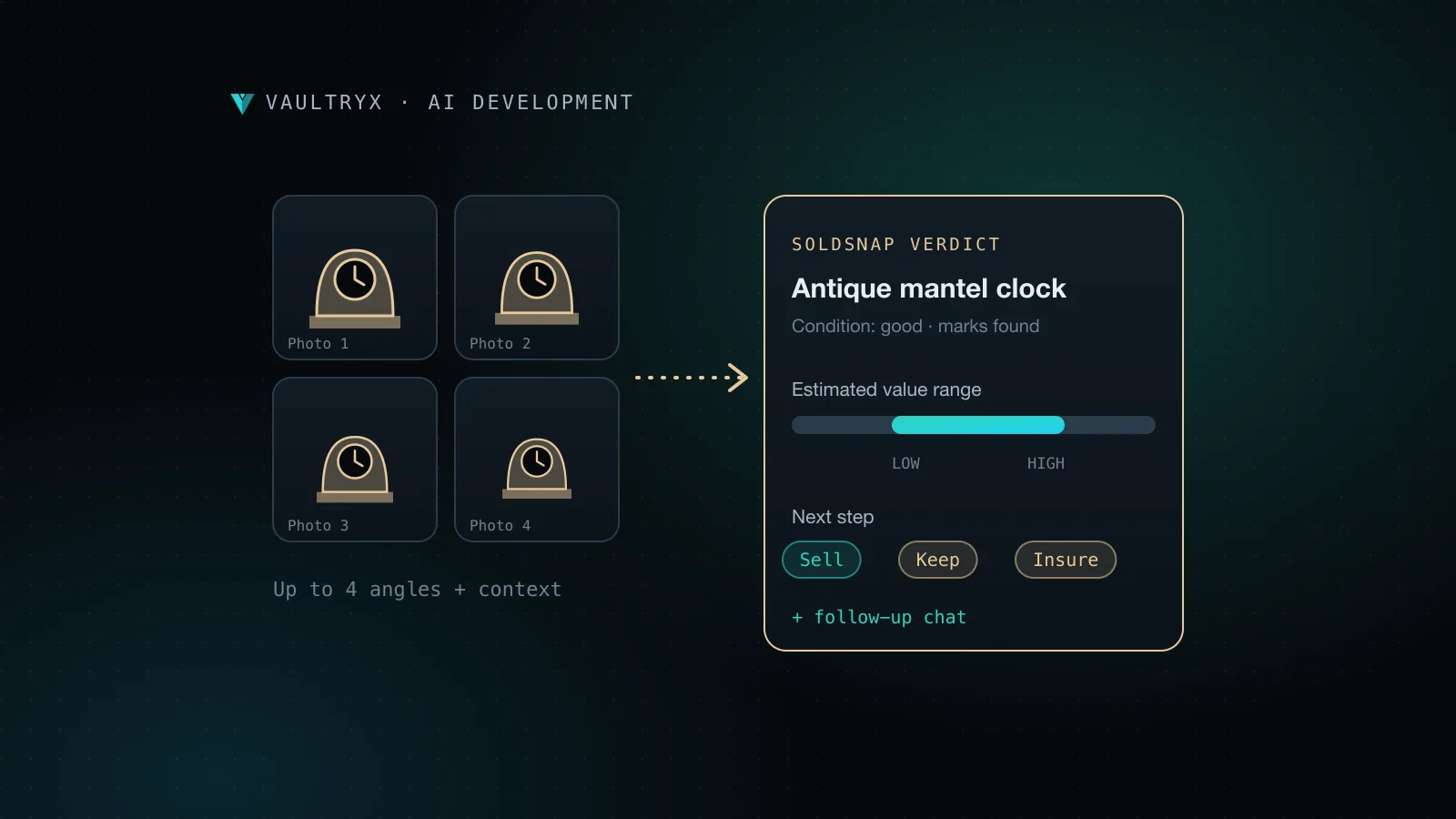
SoldSnap is an AI valuation app for antiques, luxury goods and estate items, built and run by Vaultryx. You upload up to four photos, add anything you know about the piece, and get an estimated value range with a clear next step: sell it, keep it or insure it. This post explains the product decisions behind it, how the system is put together, and what we learned that applies to any AI SaaS product.
We built SoldSnap as our own product, which is why we point to it when clients ask whether we can take an AI idea all the way to a live, paid service. You can try it at soldsnap.io.

The problem: "What is this worth?"
Many people face the same question at some point: while clearing out a parent's home, sorting an inheritance, or deciding whether a designer bag or old watch is worth reselling. The traditional options are slow or expensive. An in-person appraisal means booking an expert, and auction houses are only interested in the top end. Searching listings yourself rarely tells you which sale actually compares to the item in your hands.
SoldSnap is designed for that first decision. It gives a fast, reasoned estimate, so people know whether an item deserves a formal appraisal, a listing, or a place back on the shelf.
How SoldSnap works
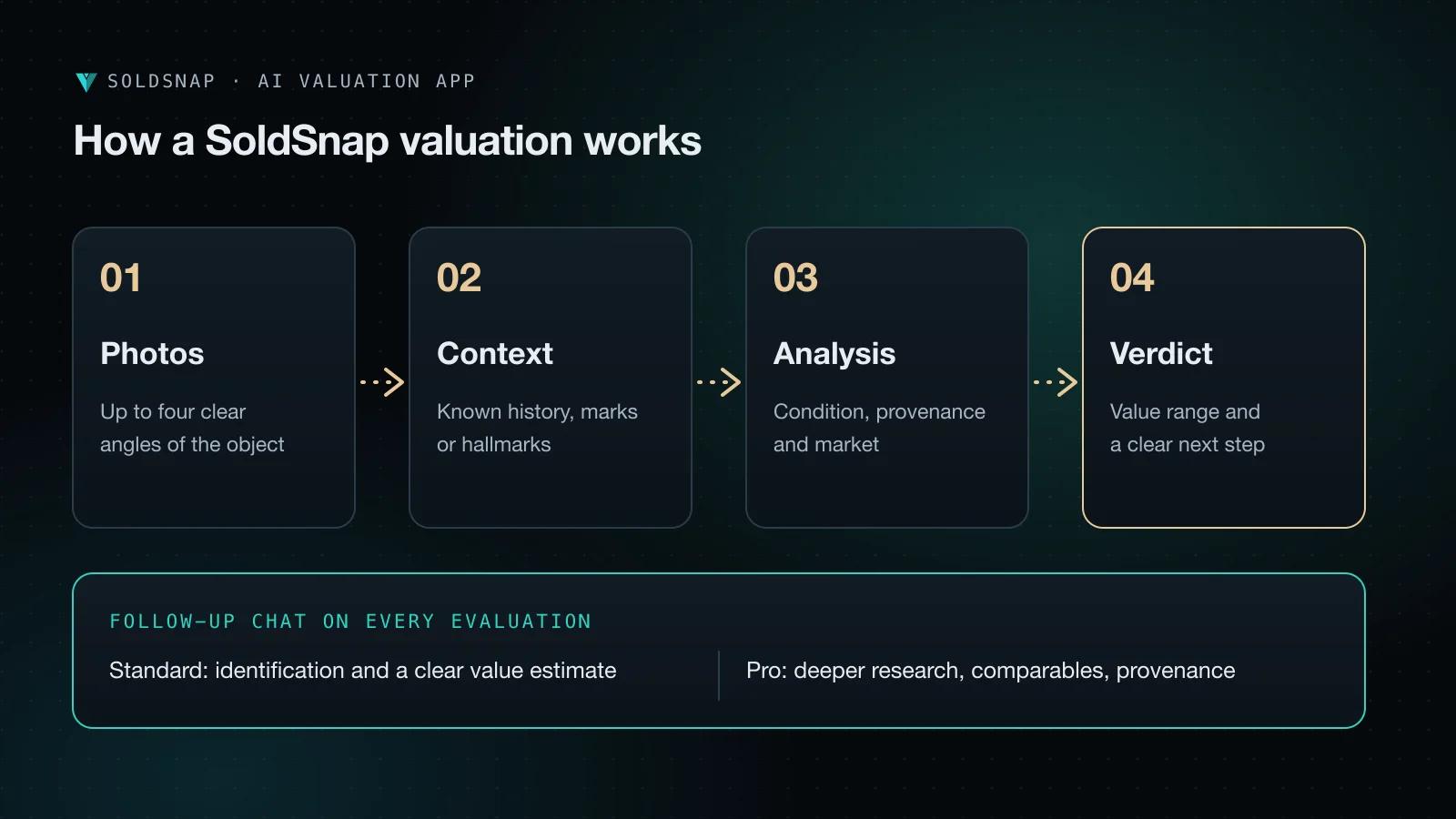
- Photos. The user uploads up to four clear angles of the object: front, back, marks and any damage.
- Context. They add what they know, such as family history, where it was bought, signatures, marks or hallmarks.
- Analysis. The system reviews condition, identifying details, provenance clues and market context.
- Verdict. The user receives an item identification, condition notes, an estimated value range and advice on what to do next, plus a follow-up chat to ask questions.
There are two evaluation tiers. Standard gives quick identification and a clear market value estimate, which suits everyday finds and resale checks. Pro adds deeper research and comparables, provenance and hallmark analysis, and tailored selling advice for higher-value or complex items.
Product decisions that shaped the app
Up to four photos, not one
A single photo hides the details that matter most for value: maker's marks, the back of a clock movement, stitching on a handbag. Allowing up to four images gives the analysis far more to work with, while keeping the upload quick on a phone.
A value range plus a next step
A single number feels precise but is rarely honest. SoldSnap returns a range and explains what moves an item toward the top or bottom of it. Every result ends with a recommendation to sell, keep or insure, because a valuation is only useful if it helps you decide.
Clear about what it is not
SoldSnap gives expert-grade estimates based on condition, comparables and market context. It is not a formal appraisal, and the product says so. For insurance or legal purposes it recommends a certified appraiser. Being upfront about the limits builds more trust than overselling the AI.
Follow-up chat on every evaluation
People always have a second question: "Would it be worth more restored?" or "Where should I sell it?" Every evaluation includes a follow-up chat that already has the item's context, so users do not have to start again.
Credits and a Family pack for shared work
Estates and inheritances are rarely handled by one person. SoldSnap sells evaluations as credits, and the one-time $60 Family pack adds 10 Standard and 18 Pro evaluations. The owner can create organisations, invite partners, allocate credits and keep a shared evaluation history, so siblings or business partners can work through a collection together.
The architecture behind the AI valuation app
SoldSnap is split into a web front end and an API, each with a clear job.
- Front end: Next.js with the App Router, React and Tailwind CSS. Public pages such as the landing page, plans, blog and share links are server-rendered so search engines can read them. Logged-in screens for evaluations, history, settings, organisations and the helpdesk render on the client and talk to the API.
- API: a Django backend at its own subdomain handles accounts, uploads, evaluations, credits, organisations, payments and the AI pipeline. Model keys and prompts never reach the browser.
- Swappable AI providers: an admin screen chooses which models run for each tier, with a provider order across Google Gemini, OpenAI and Anthropic Claude. When a better or cheaper model is released, we can switch without a code release, and the provider order lets a second service take over if the first one fails.
- Shareable results: each evaluation can be shared through a private link with its own preview, which is useful when family members or buyers need to see the result.
- SEO built in: a blog that refreshes on a schedule, generated social images, a sitemap and structured data help SoldSnap win organic traffic instead of paying for every visit.
- Hosting: the front end runs as a managed Node.js app, with the API on its own server, so each side can be deployed and scaled independently.
Lessons for anyone building an AI SaaS product
- Design around one decision. "Should I sell, keep or insure this?" is a sharper product than "AI that knows about antiques". A focused promise makes onboarding, pricing and marketing easier.
- Keep models swappable. AI providers change prices and quality every few months. A provider abstraction with an admin switch protects your margins and your uptime.
- Make the limits part of the experience. Clear disclaimers and a path to a human expert reduce support tickets and build credibility.
- Put the AI behind your API. Never call model providers from the browser. Server-side calls protect keys, let you log and rate-limit usage, and make costs predictable.
- Price for how people actually use it. One-off credits and a shared pack fit the burst of activity around an estate or a move.
- Treat SEO as a product feature. Server-rendered public pages, fast load times and a steady stream of useful articles compound over time.
If you are planning a similar product, our guide to building a SaaS MVP with Next.js covers the stack and timeline, and the AI chatbot cost breakdown explains how to estimate model costs.
Who uses SoldSnap
- Estate cleanouts: sorting a house full of belongings and needing defensible values and next steps for each piece.
- Luxury resale: checking authenticity signals and pricing branded goods before listing or consigning.
- Inheritance: understanding what an unfamiliar inherited item is, what it may be worth, and whether to keep or sell it.
FAQ
What items can SoldSnap value?
Historical objects, luxury brands, jewellery, watches, art and estate finds work best, especially items with visible marks or distinctive features. More angles produce a stronger evaluation.
Is an AI valuation as accurate as a professional appraisal?
An AI valuation app gives a fast, reasoned estimate based on condition, comparables and market context. It is not a certified appraisal, so for insurance or legal purposes you should still use a qualified appraiser.
What is the difference between Standard and Pro?
Standard gives identification and a clear value estimate. Pro adds deeper research, comparables, provenance context and tailored selling advice for higher-value or complex items.
Can Vaultryx build an AI product like this for my business?
Yes. We design, build and run AI products end to end, from the first prototype to payments, admin tools and SEO. See our AI chatbots and agents service and SaaS development service, or tell us about your idea.