AI Chatbot Cost in 2026: A Real Breakdown for Small Businesses
What an AI chatbot really costs in 2026: one-time build prices, monthly LLM and hosting bills, a simple formula to estimate usage, and the decisions that make a RAG chatbot cheap or expensive.
On this page · 7 sections
The honest answer to "what is the AI chatbot cost for my business?" is that you pay twice: once to build it, and every month to run it. Most quotes only talk about the first number. This guide breaks down both, with the price ranges you can expect in 2026, a formula to estimate your monthly model bill, and the choices that move the total up or down.
We build retrieval-augmented generation (RAG) chatbots and AI agents for small and mid-sized businesses, and the figures below are typical 2026 market ranges for both off-the-shelf and custom builds. Treat them as ranges, not a price list: your data, integrations and traffic decide where you land.
Quick answer: AI chatbot price ranges
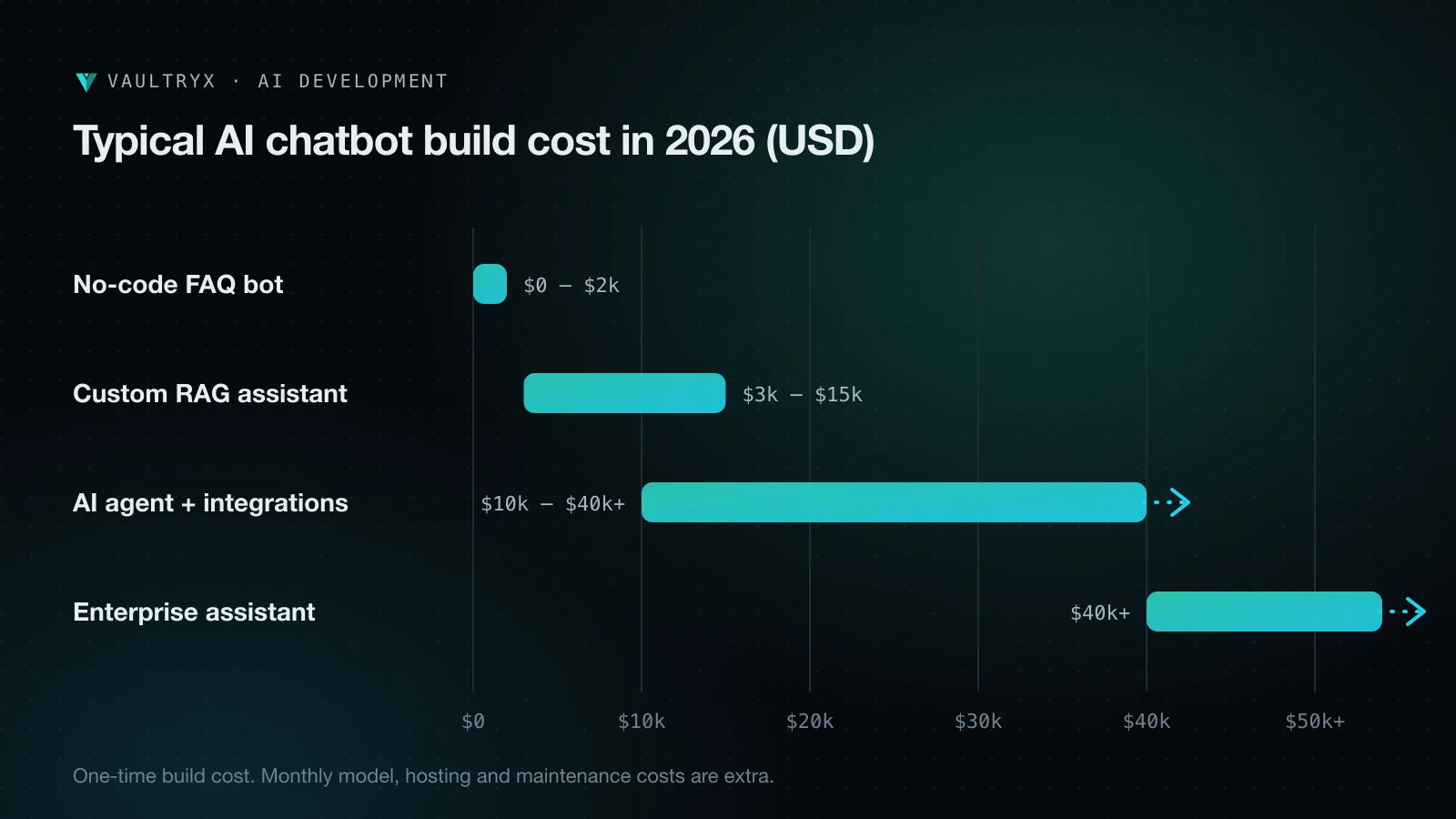
| Chatbot type | One-time build | Monthly running cost | Typical timeline |
|---|---|---|---|
| No-code FAQ bot on a platform | $0 to $2,000 | $20 to $300 | A few days |
| Custom RAG assistant on your documents | $3,000 to $15,000 | $50 to $500 | 2 to 6 weeks |
| AI agent with tool actions and integrations | $10,000 to $40,000+ | $200 to $2,000+ | 6 to 12 weeks |
| Enterprise assistant with SSO, audit logs and private hosting | $40,000+ | Depends on volume | 3 months or more |
A no-code FAQ bot is fine when the questions are predictable and the answers rarely change. A custom RAG assistant is the right step when answers live in your own documents, product data or help centre and must be accurate. An agent goes further: it books meetings, updates the CRM, checks order status or creates tickets, which means more integration work and more testing.
What you are actually paying for
Build: one-time engineering
The build covers discovery, the data pipeline that loads and splits your documents, the retrieval logic, prompt design, the chat interface or widget, authentication, integrations, an admin view for conversations, and testing. Testing is the part most people underestimate. A good team writes a set of real customer questions with the expected answers and checks every release against it, so a prompt change does not quietly break accuracy.
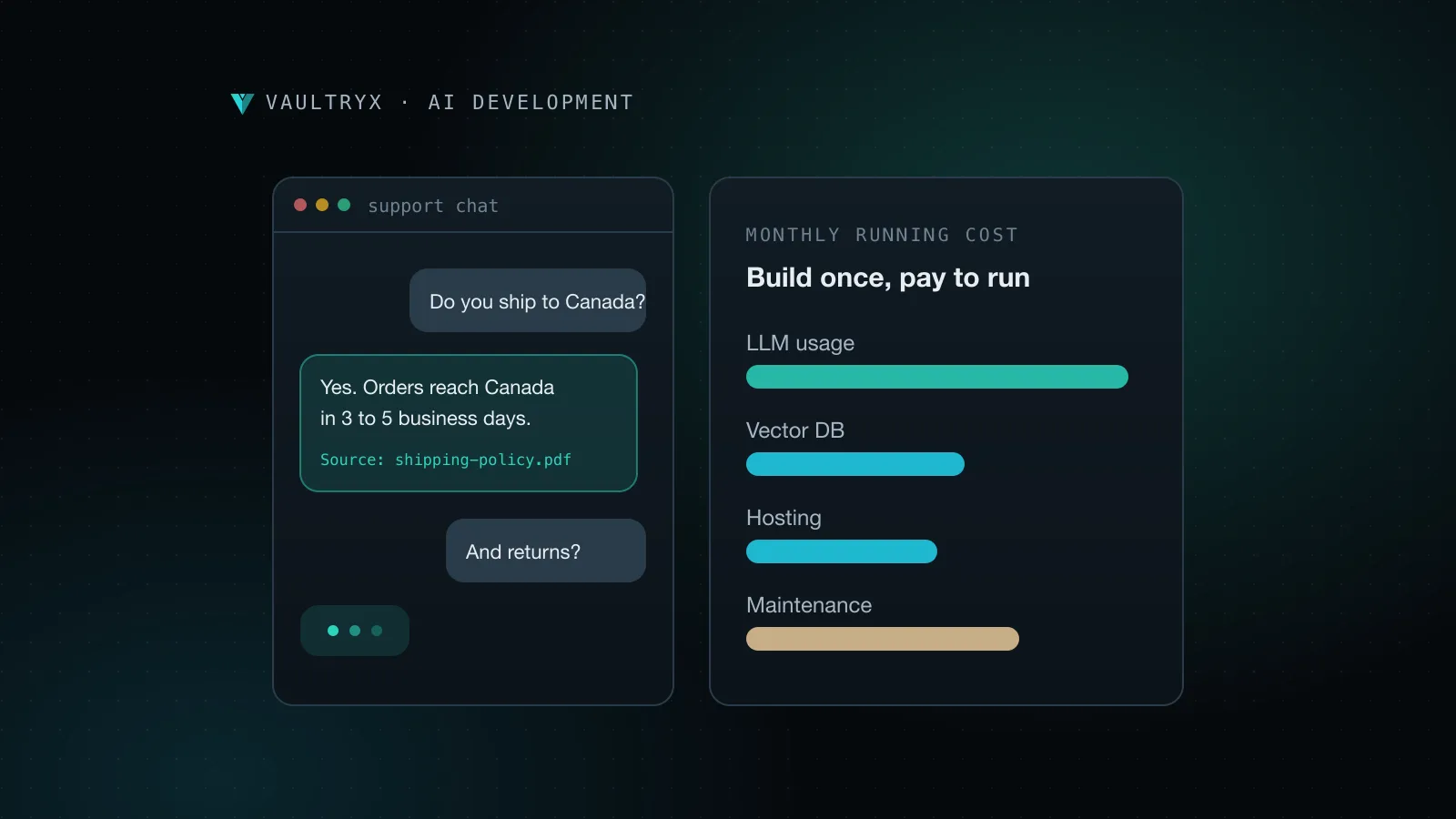
LLM usage: pay per token
Every message is sent to a large language model such as GPT, Claude or Gemini, along with the retrieved document snippets and the conversation so far. Providers charge per million tokens of input and output, and prices differ by more than ten times between small and flagship models. This is usually the biggest monthly line once traffic grows.
Vector database and hosting
Your documents are converted into embeddings and stored in a vector database such as Qdrant, pgvector or a managed service. For a small business knowledge base this often fits in a free or low tier. Add the cost of the server or serverless functions that run the chat backend, which is typically $10 to $100 a month at small-business scale.
Maintenance and content updates
Documents change, models get updated and new questions appear. Budget a few hours a month to review unanswered questions, refresh the knowledge base and re-run the test set. Many teams take a small monthly retainer for this instead of ad hoc fixes.
How to estimate your monthly LLM bill
Use this formula:
Monthly tokens = conversations per month x messages per conversation x tokens per message
Tokens per message includes the system prompt, the retrieved context and the chat history, not only what the user typed. For a RAG chatbot, 1,500 to 3,000 tokens per message is a realistic planning figure.
Example: 3,000 conversations a month, 6 messages each, 2,500 tokens per message gives 45 million tokens. At an illustrative blended price of $1 per million tokens, that is about $45 a month. On a flagship model at $10 per million tokens, the same traffic costs about $450. Always check your provider's current price page, because rates change often.
The lesson: model choice is the single biggest lever on running cost. Most support and sales questions are answered well by a smaller, faster model, with a larger model reserved for the hard cases.
Five things that push the price up
- Messy source data. Scanned PDFs, duplicated policies and outdated pages need cleaning before retrieval works, and cleaning takes time.
- Integrations. Each connection to a CRM, booking system, e-commerce platform or internal API adds design, error handling and tests.
- Actions, not just answers. Once the bot can change data, it needs permissions, confirmations and audit logs.
- Multiple languages and channels. Web chat, WhatsApp, email and voice each have their own formats and limits.
- Compliance. Data residency, PII redaction, SSO and retention rules are essential in finance, health and legal work, and they add scope.
How to keep chatbot costs down
- Start with one high-volume use case, such as order status or pre-sales questions, and expand after it proves its value.
- Route simple questions to a small model and escalate only when needed.
- Cache answers to the most frequent questions.
- Keep the retrieved context short: five relevant snippets beat twenty loosely related ones.
- Measure deflection and conversion from day one, so the cost conversation is about return, not just spend.
If parts of the workflow are repetitive but do not need a conversation, a plain automation is often cheaper than a chatbot. Our AI automation service covers those cases with n8n and Python.
Off-the-shelf tool or custom chatbot?
Choose an off-the-shelf tool when your content is a simple FAQ, you are happy with the vendor's widget and limits, and you want to launch this week. Choose a custom build when accuracy on your own documents matters, when the bot needs to act inside your systems, when you want to own the data and prompts, or when per-seat or per-resolution pricing would become expensive at your volume.
For a real example of an AI product with model choice and cost control built in, read how we built SoldSnap, an AI valuation app.
FAQ
How much does a simple AI chatbot cost?
A simple FAQ bot built on a no-code platform costs from nothing to about $2,000 to set up, plus a monthly subscription of roughly $20 to $300 depending on the platform and volume.
Why is a custom RAG chatbot more expensive?
Because it is engineered around your data: loading and splitting documents, tuning retrieval, testing accuracy against real questions, and integrating with your systems. That work is what stops the bot from making up answers.
Are there hidden costs?
The usual surprises are model usage growing with traffic, cleaning source documents, and ongoing maintenance. Ask any vendor to show the monthly running cost at your expected volume before you sign.
How long does it take to build an AI chatbot?
A focused RAG assistant usually takes two to six weeks from discovery to launch. Agents with several integrations take six to twelve weeks.
Want a fixed price for your chatbot? See our AI chatbot development service or start a project and we will send a written quote after a free discovery call.