How to Build a SaaS MVP with Next.js: Stack, Timeline and Cost
A practical plan for building a SaaS MVP with Next.js: what to include on day one, the stack that scales, a week-by-week timeline, realistic costs and the mistakes that slow founders down.
On this page · 8 sections
A SaaS MVP is the smallest version of your product that a real customer will pay for. Not a clickable mock-up and not a full platform: one workflow that solves one painful problem, wrapped in the basics every paying customer expects, such as accounts, billing and a working support email. This guide shows how to build that with Next.js, what to leave out, how long it takes and what it costs.
It is written for founders and product owners who want to launch quickly without creating a codebase they have to throw away six months later.
What a SaaS MVP must include (and what can wait)
Every SaaS MVP needs five things on launch day:
- The core workflow. The one job your customer hires the product to do, done well from start to finish.
- Accounts and access. Sign up, log in, password reset and, if you sell to teams, organisations with roles.
- Billing. A pricing page, checkout, subscription or credit handling, invoices and a way to cancel.
- Transactional email. Welcome, verification, receipts and the notifications your workflow depends on.
- Basic operations. Error tracking, backups, an admin view to help customers, and analytics on the activation step.
What can wait: a mobile app, a public API, advanced reporting, dozens of integrations, white-labelling and complex permission matrices. Each of these is easier to design once paying customers tell you what they actually use.
The Next.js SaaS stack we recommend
| Layer | Choice | Why |
|---|---|---|
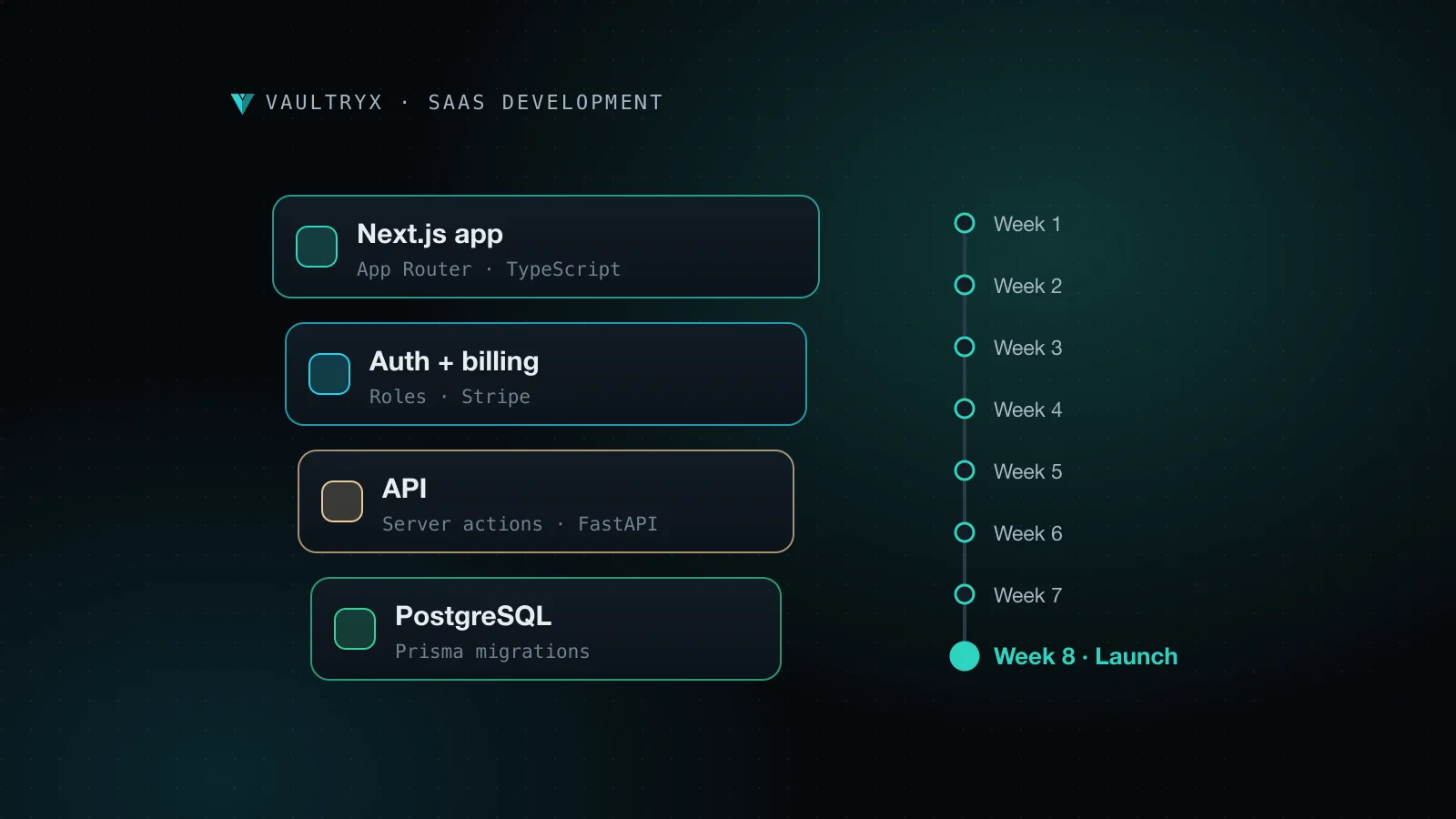
| Front end and server | Next.js App Router with TypeScript | Server rendering for SEO and speed, server actions for forms, one codebase |
| UI | Tailwind CSS and shadcn/ui | Accessible components you own, fast to customise |
| Auth | Auth.js, Clerk or Supabase Auth | Proven flows for sessions, OAuth and multi-factor authentication |
| Database | PostgreSQL or MySQL with Prisma | Typed queries, versioned migrations, easy local setup |
| Payments | Stripe | Checkout, subscriptions, invoices and tax in one place |
| Resend or a transactional SMTP provider | Reliable delivery and templates written in React | |
| AI or heavy processing | A FastAPI or Django service when needed | Python libraries for machine learning and long-running jobs |
| Monitoring | Sentry plus uptime checks | Know about failures before customers report them |
Next.js is a good default because marketing pages, the logged-in app and backend logic live in one TypeScript project. When the product needs heavy Python work, such as document processing or model pipelines, a separate FastAPI or Django API is cleaner than forcing it into Node. SoldSnap, which we cover below, uses exactly that split.
An 8-week SaaS MVP timeline
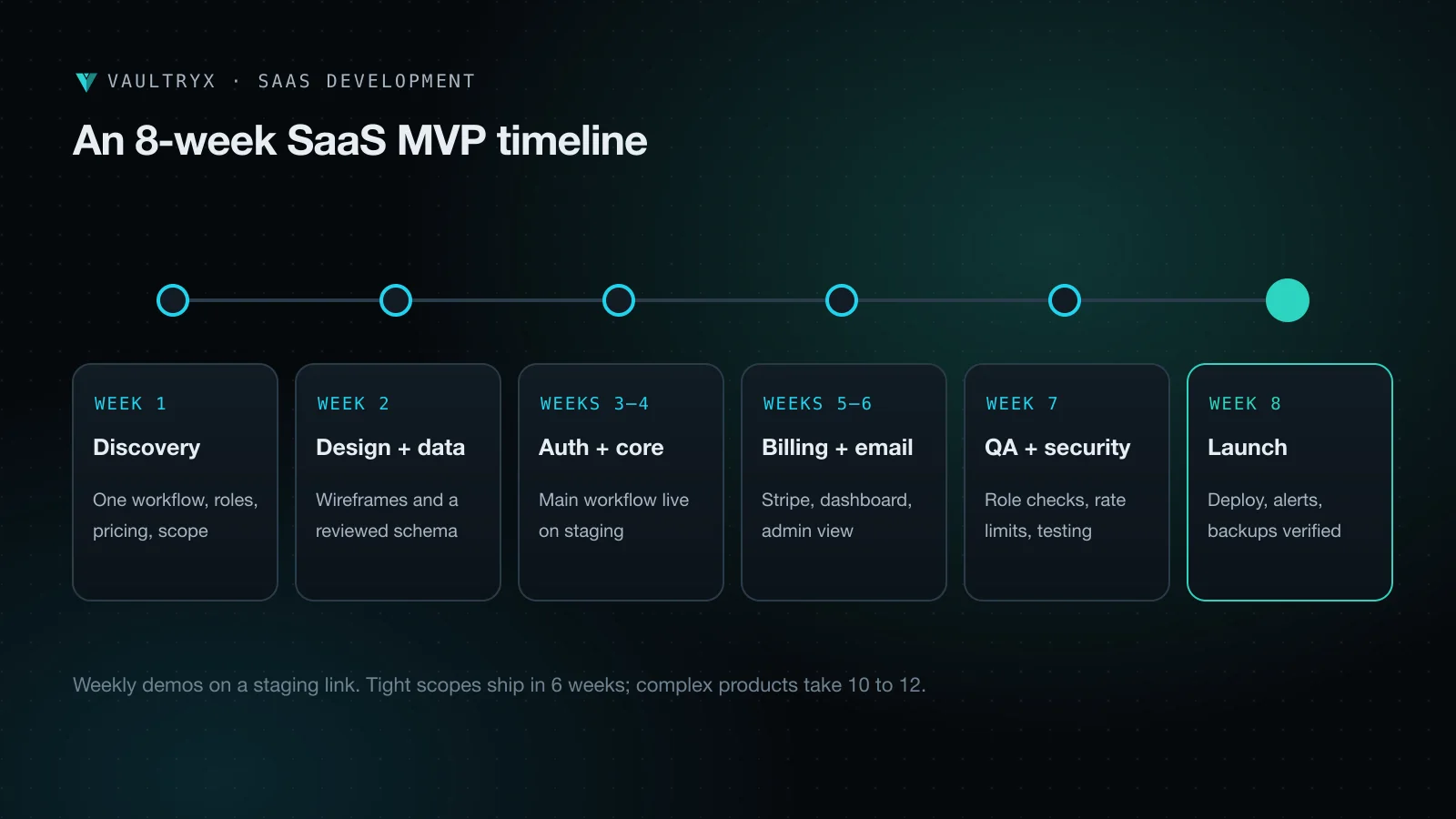
- Week 1: discovery and scope. Agree on the one workflow, the user roles, the pricing model and what is explicitly out of scope. Write it down.
- Week 2: design and data model. Wireframes for the key screens and a database schema reviewed before any feature code.
- Weeks 3 and 4: auth and the core workflow. Accounts, organisations if needed, and the main feature working end to end on a staging link.
- Weeks 5 and 6: billing, dashboard and email. Stripe checkout and webhooks, the customer dashboard, transactional emails and the admin view.
- Week 7: QA and security pass. Role checks on every server action, rate limits on public forms, input validation, performance testing and a full regression run.
- Week 8: launch and monitoring. Production deploy, analytics, error alerts, backups verified and a short list of fixes from the first users.
A tight scope can ship in six weeks. Marketplaces, multi-sided products or heavy integrations usually take ten to twelve. Weekly demos on a staging link keep everyone honest about progress.
How much does a SaaS MVP cost?
Market prices in 2026 vary widely with scope and team location. As a guide:
- Single-workflow MVP with auth, billing and an admin view: roughly $5,000 to $15,000.
- Multi-role product with organisations, dashboards and a few integrations: roughly $15,000 to $35,000.
- Complex platforms with marketplaces, real-time features or heavy AI processing: $35,000 and up.
Running costs at launch are usually small: hosting, database, email and monitoring often total $50 to $300 a month until you have meaningful traffic. AI features add model usage on top; our AI chatbot cost breakdown shows how to estimate it.
The cheapest MVP is the one with the smallest scope, not the lowest hourly rate. Every feature you cut before week one saves far more than negotiating the price.
Architecture decisions that save you later
- Multi-tenancy from day one. Put an organisation id on every business table now, even if each customer has one user. Retrofitting it later touches every query.
- Server-side permissions. Check the user's role inside every server action and API route, not only in the interface.
- Migrations in Git. Every database change is a reviewed migration, so staging and production never drift.
- Webhooks for external events. Let Stripe and other services tell you when something changed instead of polling them.
- Cache public pages. Static or incrementally regenerated marketing and blog pages are fast, cheap and good for search rankings.
- Audit logs for sensitive actions. Logins, role changes and data exports should leave a trail. Enterprise buyers will ask for it.
Common SaaS MVP mistakes
- Building for every possible customer instead of the first ten.
- Skipping billing to launch faster, then discovering nobody converts when you finally ask for money.
- Choosing a niche framework the next developer cannot support.
- Treating a prototype from an AI app builder as production code without a security review. Our Lovable production-ready checklist covers what to fix first.
- No analytics on the activation step, so you cannot tell why trials do not convert.
Real example: SoldSnap
SoldSnap is our own AI valuation product for antiques, luxury and estate items. It pairs a Next.js front end, with server-rendered public pages for search, with a Django API that runs the AI analysis, credits, organisations and payments. Read the full story in how we built SoldSnap.
FAQ
How long does it take to build a SaaS MVP?
Most focused SaaS MVPs take six to ten weeks from discovery to launch. Scope is the biggest factor, followed by the number of integrations.
Is Next.js good for SaaS?
Yes. It handles marketing pages, the logged-in app and server logic in one TypeScript codebase, with strong SEO and performance by default. Add a Python service only when the product needs it.
Should I use a no-code tool instead?
No-code and AI app builders are great for validating an idea. Once customers pay, you need code you control, proper security and a release process, which is where a custom build pays off.
Who owns the code?
You should. Make sure your contract transfers the code, infrastructure and accounts to you at the end of the project.
Planning your MVP? Our SaaS and MVP development service delivers working software every week on a staging link. Start a project to get a fixed proposal within 48 hours of the discovery call.